Infinite Games: How AI Creates Never-Ending Adventures in Minecraft for My Kids
"Dad, the NPCs talk to me in Catalan and they know my name. Is this magic?" — No, son. It's 4 Docker containers, an LLM and 279 lines of dialogue generated at 3 AM.
Three months ago I started building a Minecraft server for my kids. The idea was simple: a medieval world where they could play together. But somewhere between configuring the first NPC and seeing their faces when that NPC spoke in Catalan, the project became something else. It became a game with no ending —literally— because every night, while they sleep, an AI reviews what they've done, generates new adventures, new dialogues, new quests, and when they wake up in the morning, the world has changed.
This article is the full technical walkthrough of AIMC (AI Minecraft): the architecture, the decisions, the failures, and why I believe projects like this represent something bigger than a Minecraft server. It's a demonstration that generative AI isn't only for corporate dashboards —it's for getting your eight-year-old to practice reading comprehension in his native language without realizing he's learning.
The vision: a game that evolves while you sleep
Vanilla Minecraft has a problem every parent knows: after two weeks, the kids drop it. Not because the game is bad, but because it's static. You build a house, kill the Ender Dragon, and that's it. No emergent narrative. No surprises. The world doesn't need you.
The question I asked myself was: what if the world did need you? What if every time you logged in there was something new? A merchant who arrived with an urgent commission. A rumor about a cave to the north where a dark wizard is amassing power. A blacksmith who needs rare materials and offers an enchanted sword in return. Not a random dice-rolled event —a coherent story, one that remembers what you did yesterday, that reacts to your decisions.
That's the vision behind AIMC. And it's not theoretical: it's been running for several weeks.
The architecture: four services, one brain
AIMC runs as a Docker Compose stack with four services that talk to each other:
services:
  postgres:       # Persistent state — adventures, quests, players
  ai-director:    # Brain — FastAPI + Claude + TTS pipeline
  paper:          # Minecraft server — Paper 1.21.4 + bridge plugin
  cdn:            # nginx — resource packs + audio for clients
The flow is deliberately simple. The player interacts with an NPC in-game. The bridge plugin (Java, embedded Javalin HTTP) intercepts that click and sends it to the AI Director (Python, FastAPI). The Director queries the player's state in PostgreSQL, decides what dialogue to show, generates the response if needed via Claude, synthesizes audio via Edge TTS, and returns the text + sound command to the bridge. The bridge displays the dialogue in the game chat and plays the NPC's voice. All in under two seconds.
Paper 1.21.4
Optimized Minecraft server. Build 232 pinned (Citizens breaks on later builds). Port 25566 game + 8765 HTTP bridge.
AI Director (FastAPI)
Python with uv. Anthropic SDK, edge-tts, ffmpeg, SQLAlchemy 2 async, httpx. Port 8000. The system's brain.
PostgreSQL 16
7 Alembic migrations. Tables: adventures, world_bibles, deployments, player_quest_status, dialogue_trees.
CDN (nginx)
Serves resource packs + schematics from the shared aimc-audio volume. Clients download audio from here.
The bridge plugin: Java that speaks HTTP
The bridge between Minecraft and the AI is a Java plugin with Javalin 6.3 embedded, exposing a REST API. It's not a client mod —it's pure server-side. The endpoints cover everything the AI needs to operate on the world:
# Main bridge routes (AIMC v0.6.0)
/health              # Heartbeat
/cmd                 # Execute MC commands (configurable allowlist)
/state               # Player position + inventory
/npc/spawn           # Create NPC with skin, role, position
/structure/paste-schematic  # Paste .schematic via FAWE
/world/fill-region   # Fill region with a block
/world/prepare-stage # Prepare flat canvas for building
/adventure/deploy    # Deploy complete adventure (NPCs + dialogues + quests)
/chest/place         # Place chest with loot
/mob/spawn           # Spawn mobs with NBT (villager profession, etc.)
The decision to build an HTTP bridge instead of a monolithic plugin was deliberate: the AI Director is Python, and I want to iterate on AI logic without recompiling Java. The bridge is a thin adapter that translates high-level intentions ("place a blacksmith NPC here") into Bukkit commands. The intelligence lives outside the game.
113 NPCs that speak Catalan
My kids speak Catalan. It's their mother tongue, the language they use at school, the one they speak with their friends. But almost all the digital content they consume —games, YouTube, series— is in Spanish or English. Catalan is relegated to homework.
AIMC inverts that equation. Every NPC speaks Catalan. Every line of dialogue, every quest, every item description is in Catalan. And not just text: the NPCs have voices.
The TTS pipeline
The pipeline is: Story Bible (Claude generates narrative) → Dialogue Tree (structured into nodes with conditions) → Edge TTS (synthesizes audio) → Resource Pack (packages OGG Vorbis) → CDN (serves to client).
The voices are ca-ES-EnricNeural for male characters and ca-ES-JoanaNeural for female —the Catalan voices from Microsoft Edge TTS, free and surprisingly natural. The audio is converted to OGG Vorbis mono 44.1kHz with ffmpeg (Minecraft's native format) and packaged in a resource pack that the client downloads automatically on connection.
The result is that when a child clicks on "Mossèn Llorenç" in the Apex church, the priest says out loud, in Catalan: "Benvingut, aventurer. L'església guarda secrets antics que potser podrien ajudar-te en la teva missió." And the text appears in the chat for them to read.
Listen to the NPCs
Each NPC has its own voice generated by Edge TTS in Catalan. Here are some real in-game greetings — 599 audio files in total:
Lord d'Apex
The feudal lord of the city
Pare Bernat
The church priest
Mestre Pere
The tower scholar
Joan el Ferrer
The village blacksmith
Adela del Mercat
The market vendor
Marc l'Aprenent
The young student
Characters with personality
NPCs aren't static mannequins. Each has a role (lord, blacksmith, mage, innkeeper, guard), an assigned skin from the Hermitcraft pool (Grian for the Lord, Etho for scholars, Technoblade for smiths), a block-precise position —verified with a 6-step protocol that checks floor, feet, head and corners— and a dialogue tree that changes based on the player's state.
The blacksmith Joan, for example, starts with an introduction. If the player has accepted the main quest, Joan mentions he's heard rumors about the lost relic. If the player has already completed the quest, Joan congratulates them and offers a discount at his shop. There are 279 dialogue lines just for the main adventure, and every NPC knows where the player is in the story.
The city of Apex has 61 active NPCs with names, roles and personalities. Beyond the narrative, 13 of them are merchants with functional shops —6 market stalls (vegetables, meat, fish, bread, wool, tools), 2 general stores, a smithy, an armory, an inn, a tavern, and a luxury market— each with their own inventory through the Bukkit Merchant API. The player right-clicks and the native Minecraft trading interface opens. Zero chat commands. Everything designed so a six-year-old can use it.
The RPG system: classes, skills and parties
A world with story needs mechanics. The latest project phase (Phase 44) added a complete RPG system:
| Class | Archetype | Primary trees | Active ability |
|---|---|---|---|
| Paladin | Tank | heavy_armor + heavy_weapons | War Crit (8s taunt) |
| Mage | DPS | enchanting + archery | Fireball (projectile) |
| Druid | Healer | farming + alchemy | Healing Aura (5 blocks) |
Behind this is ValhallaMMO, a skill tree plugin with branched perks that advances via XP on relevant actions (the smith improves by forging, the mage by enchanting). Classes are defined in a Python file (class_config.py) that the AI Director reads to assign starting items, skill points and class tags to the player. The bridge translates that into ValhallaMMO commands.
For cooperative play, AlessioDP Parties (with a shared PostgreSQL backend) allows creating groups. And on the client, Xaero's Minimap shows allies, NPCs and objectives on a minimap that syncs with the server via MapModCompanion.
Everything is operated from the in-game hotbar. No /party create in chat. An item in slot 9 opens an inventory menu with clickable buttons. If a child can click, they can play.
The adventure: quests that matter
The main adventure of Apex —"L'Enigma d'Apex"— is an 8-step chain with a complete narrative arc: a lost relic, a dark wizard, clues scattered across the city, a final dungeon, and a boss encounter. Claude generates it from a Story Bible that defines the tone, characters and plot threads. The AI Director structures it as a node graph with advancement conditions and deploys it to the server.
What a deployed adventure contains
- Main quest with 8 steps, NPC triggers, conditional dialogue, item rewards (emeralds as currency) and compass tracker (lodestone NBT pointing to the next objective).
- 9 side quests generated by LLM —each with its dialogue chain, rewards and conditions.
- Dungeon ("La Cova del Mag Fosc"): procedural maze, mob rooms, loot chests, final boss, return portal.
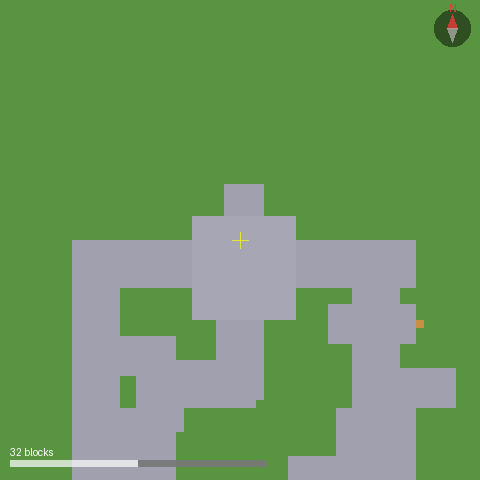
Top-down view of the dungeon: entrance, three paths, mob rooms, dead-ends with chests and boss chamber. - Quest journal: a Written Book the player carries + an inventory GUI ("Diari de Missions") with each quest and its status.
- BossBar radar: boss bar showing direction and distance to the active objective.
- Sidebar tracker: lateral scoreboard with active quest progress.
- Custom map:
ApexMapRendererdraws a world map with NPC cursors, player position and active objective. Adjustable zoom via command.
And when the player completes all of this, the question is: what now?
The infinite game: the cron that changes everything
Here's the heart of the project. The answer to "what now?" is: tomorrow there's more.
The idea is a nightly cron job that runs a full generation cycle:
- Analysis — the AI Director reads
player_quest_statusfrom PostgreSQL. What quests has the player completed? Which NPCs have they talked to? What level are they? What items do they carry? - Narrative generation — Claude receives the player state + the current Story Bible and generates new plot branches. A merchant arrives with news from the north. The blacksmith's daughter has disappeared. There are rumors of an abandoned fortress beyond the river.
- Content production — the Director generates dialogues for new NPCs, quest conditions, reward items, spawn positions.
- TTS batch — Edge TTS synthesizes all new voice lines. ffmpeg converts them to OGG Vorbis.
- Resource pack rebuild — the builder packages the new audio, updates the manifest, serves it via CDN.
- World building — if the narrative requires a new structure (a shop, a camp, a dungeon), the Director can place it via FAWE using schematics from the curated catalog.
- Deploy — the
/adventure/deploybridge endpoint receives the complete package and applies it to the world live.
When my kids log in the next morning, there's a new quest waiting for them. An NPC that wasn't there yesterday greets them by name. The world has evolved. And the only thing I did was sleep.
The infinite game is not a marketing promise. It's a cron job, an LLM and a database.
The city: schematics, not procedural
One of the most formative failures of the project was trying to generate cities procedurally. I went through 9 iterations —layout engines, zone bitmasks, density tuning, vegetation passes— and the result was always the same: overlapping houses, empty interiors, streets going nowhere. My kids looked at it with the politeness of someone who knows dad worked hard, but the first time I showed them a procedural screenshot, the older one said: "It's OK, but it doesn't look real."
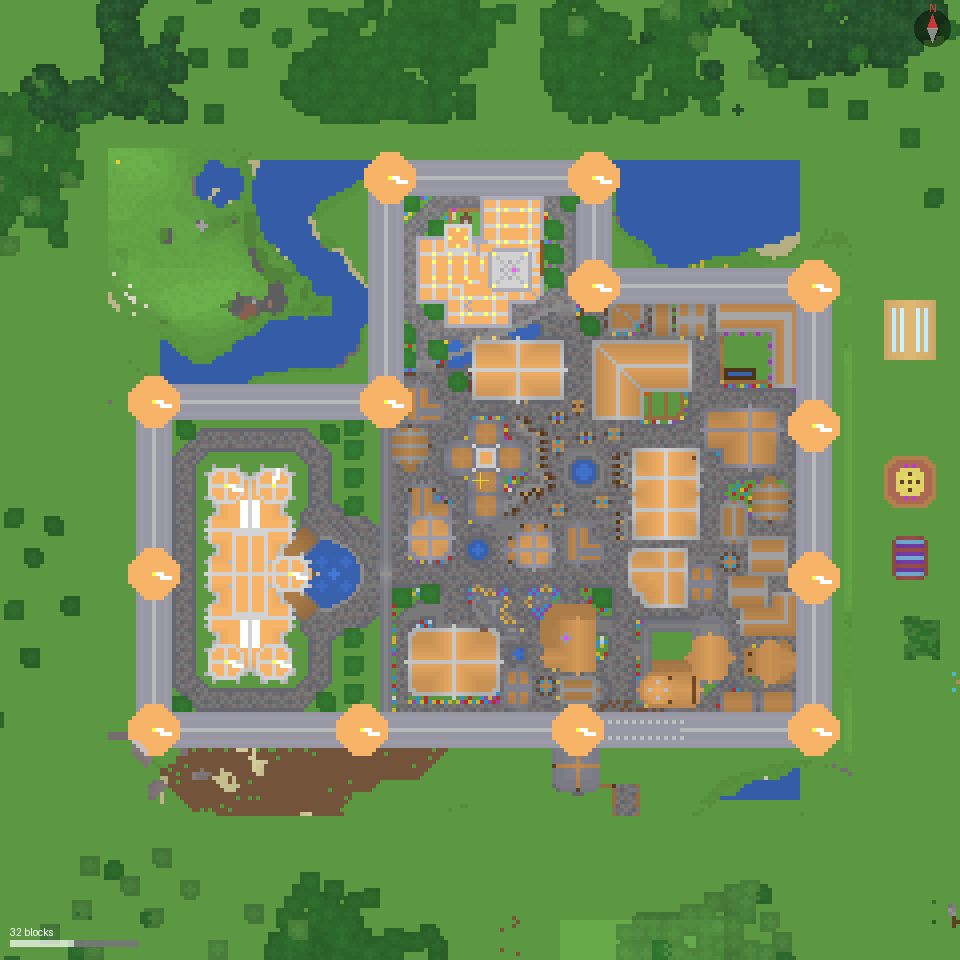
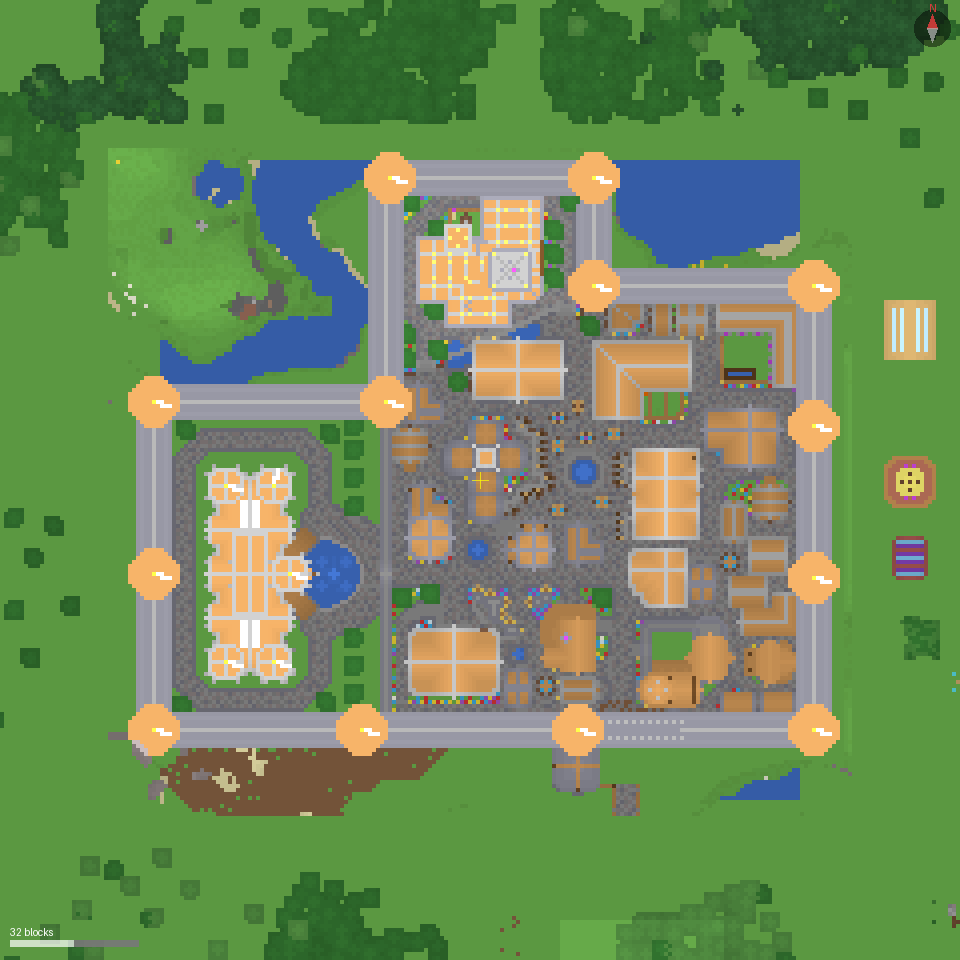
The pivot was radical: stop generating and start curating. The Minecraft community has been building spectacular medieval cities for 15 years. Apex Medieval, a 186x167-block schematic downloaded from mcbuild.org, has cobblestone streets, a gothic cathedral, a castle with a library and throne room, a three-story inn, a market square with stalls, a smithy with a functional anvil, and houses with interiors detailed down to the curtains.
FastAsyncWorldEdit (FAWE) pastes these schematics into the server world asynchronously, without lag. The pipeline is: download the schematic → paste via the bridge API → capture POIs by walking the map (a 20-minute investment per location, reusable across every wipe) → deploy NPCs at captured positions → visually verify with a top-down renderer that reads region files directly.
The result is a world that looks hand-built, because it was —by another human, years ago, with a dedication no LLM can match today. The AI brings the life (NPCs, dialogues, quests, voice), not the architecture. It's a combination that works far better than either on its own.
The numbers
| Metric | Value |
|---|---|
| Active NPCs (Apex) | 61 with name + role + skin + dialogue |
| Total NPCs deployed | 113 |
| Dialogue lines (main adventure) | 279 |
| Merchants with functional shop | 13 |
| Items for sale | 50+ |
| Captured POIs | 30 |
| TTS voices generated | 279+ OGG files |
| Active quests | 1 main (8 steps) + 9 side |
| RPG classes | 3 (Paladin, Mage, Druid) |
| Alembic migrations (DB) | 7 |
| Bridge endpoints | 15+ |
| Hosting cost | 0 (own bare metal) |
| TTS cost | 0 (Edge TTS, free) |
| LLM cost | Existing Claude subscription |
What I learned (and what went wrong)
Instructive failures
- Procedural generation doesn't work for AAA quality. I spent weeks tuning layouts, densities, vegetation. The result never passed the test of an eight-year-old. Lesson: if quality human-made content exists, use it. AI is better at composing existing pieces than generating from scratch.
- Citizens breaks with Paper NMS. The most popular NPC plugin depends on NMS code injection that breaks with every Paper update. FancyNpcs uses packet-based NPCs: no dependency on internals, survives updates. The dependency on internal server implementation is exactly the same trap as in enterprise software.
- The Y offset is hell. Every schematic format (MCEdit
.schematic, Sponge.schem, WorldEdit) encodes the offset differently. I spent three entire sessions with NPCs sunk into the ground or floating in the air before standardizing: the surface Y on superflat is 2, not 66. Apex schematic Y is 5. Each paste requirespaste_pos = target - WEOffset. - HTTP/2 vs HTTP/1.1. The Anthropic SDK uses HTTP/2 by default. Uvicorn serves HTTP/1.1. The bridge was proxying Director requests to the Claude API and getting 400 "Invalid HTTP request" with no useful error message. Three hours of debugging for one config line.
Decisions that worked
- HTTP bridge instead of monolithic plugin. Iterating in Python is 10x faster than recompiling Java. The bridge has stayed stable while the Director has been rewritten three times.
- Edge TTS for Catalan. Microsoft's voices are free, need no API key, and support Catalan with surprisingly good quality. ElevenLabs sounds better, but costs money and has no native Catalan.
- Shared volume for audio.
aimc-audiois a Docker volume mounted in the Director (rw) and the CDN (ro). The Director generates OGG files, the CDN serves them. No copies, no sync, no S3. - Manual POI capture. Walking the map and saying "this is the smithy, this is the church" takes 20 minutes and produces perfect coordinates. Five attempts at auto-detecting buildings with heuristics gave unusable results.
The angle nobody talks about: parenting + engineering + AI
Most articles about applied AI talk about enterprise, productivity, digital transformation. Fair enough. But there's a dimension that gets mentioned too little: AI as a parenting tool.
I'm not building AIMC to publish a paper or to monetize it. I'm building it because I want to spend time with my kids doing something that fascinates them, and I want that time to have value beyond entertainment. I want them to read Catalan without it feeling like homework. I want them to learn teamwork (the Paladin tanks while the Druid heals —that's coordination). I want them to experience a world that responds to their decisions, that teaches them that actions have narrative consequences.
And I want them to see that their father can build something like this. That technology isn't a black box: it's a tool you can shape to create experiences that don't exist in any marketplace.
AI makes this possible because it removes the two barriers that previously made it impractical: content and scale. Before, creating 279 coherent dialogue lines with narrative arcs in Catalan would have been weeks of work. Claude does it in minutes. Before, synthesizing voice in Catalan required expensive licenses or robotic voices. Edge TTS solves it for free. Before, designing a quest system with persistent state and conditional dialogues was a months-long engineering project. With an LLM that generates quest configurations from a narrative in natural language, it's an afternoon.
I'm not saying it's easy. It's 44 phases, hundreds of hours, and the project is far from finished. But the ratio between effort and result has fundamentally changed. A parent with engineering skills and access to an LLM can build experiences that previously required an indie studio with a budget.
What comes next
The nightly cron is the missing piece to close the loop. Today adventures are generated when I request them; tomorrow they'll generate themselves. The pipeline is ready —every piece (state analysis, narrative generation, TTS, deploy) works independently— and all that remains is orchestrating them in a scheduled job.
Beyond that:
- Day/night NPC routines — NPCs will walk to their homes at nightfall and return to their posts at dawn. An in-game cron that moves FancyNpcs through predefined positions.
- New locations — Vufflens Castle, Fortress Town, and other schematics from the curated catalog, each with its own NPC roster and adventure.
- Narrative combat — bandits on the outskirts, random encounters on the road, themed mobs per zone.
- Directed educational content — quests with disguised math problems ("the merchant needs 3 ingots and each costs 5 emeralds, how many do you need?"), historical facts about 14th-century Catalonia integrated into NPC dialogues.
- Scaled multiplayer — today two kids play. The system scales without changes to 10 —each player with their own quest state, progress and class.
Conclusion
AIMC is not a product. It's a project by an engineer-father who wants his kids to experience something you can't buy in any store: a world that knows them, speaks their language, and grows with them. It's also a technical demonstration that the current generative AI stack —LLMs, TTS, agentic orchestration— is mature enough to build rich interactive experiences without an enterprise budget.
Four Docker containers. A Claude subscription. Free Catalan voices. And a kid who this morning told me: "Papa, el Mossèn Llorenç m'ha dit que la reliquia és a la cova del nord. Puc anar-hi?"
Yes, son. You can go. And tomorrow there'll be something new waiting for you.
Back to articles